Wisteria is generous with disappointment. Plant one and you may wait years for a single flower, then watch the same plant lever a downpipe off the wall in a wet November. Almost every complaint gardeners make about wisteria — no blooms, straggly growth, cracked render, shoots in the loft — comes back to a handful of mistakes that are easy to avoid once you know what they are.
Buying the wrong plant, or planting it in the wrong place
Most wisterias sold cheaply are seed-raised. They can take fifteen or twenty years to flower, and some never do more than produce leaves. Buy a grafted named cultivar instead — the graft is what guarantees you a plant that flowers while you are still young enough to enjoy it. Good choices include Wisteria sinensis 'Prolific' and 'Domino', and Wisteria floribunda 'Macrobotrys' if you have the space for its long racemes.
Plant the graft union at or just above soil level, never buried. If it disappears below the surface the named cultivar can root and the vigorous rootstock takes over, which is one reason a "blue wisteria" suddenly turns into a mass of dull mauve flowers, or none at all. Watch for strong shoots coming from below the graft and cut them out at once.
Position matters just as much. Wisteria wants sun — six hours or more — and shelter. Plant it roughly 30–45cm (12–18in) out from the wall rather than tight against it, so it sits outside the rain shadow, then lean the young stem in and tie it to its support. It will find the wall on its own.
Overfeeding, and feeding the wrong thing
Wisteria makes its own nitrogen through root nodules, so a nitrogen-rich feed or a general-purpose fertiliser mostly produces leaves and long, sappy growth. That is the opposite of what you want.
Feed lightly. A mulch of well-rotted garden compost in spring is usually enough. If your soil is thin and the plant looks pale, a high-potash feed — the sort sold for tomatoes — from late spring until the flower buds colour up will help. Do not feed a strong-growing plant at all. Restriction, not richness, encourages flowers, which is why wisterias against old walls so often outperform pampered ones in open borders. If your plant sulps about in deep, fertile soil, sink a paving slab or a sheet of slate vertically about 45cm from the trunk to check the roots, or grow it in a large pot sunk into the ground.
Pruning at the wrong time — or not at all
This is the single biggest reason wisterias fail to flower. Unpruned, the plant puts its energy into long, whippy growth, and flower buds form only on short, stubby spurs. Pruning creates those spurs, and it needs doing twice a year.
- Summer (July or August): cut all the long, trailing shoots of the current season back to about five or six buds from the main framework.
- Winter (January or February): go back over the same spurs and cut them again, this time to two or three buds. The fat, rounded buds you are leaving are next year's flowers.
- Never prune in spring. By then the flower buds are swelling and you will cut them off. If you have missed the winter window, wait.
- Leave the framework alone. The permanent stems that carry the spurs should be tied in and left to thicken.
If your wisteria has been left for years and is a tangle, do not hard-prune the whole thing in one go — you may lose several seasons of flowers and shock the plant into nothing but leaf. Thin it over two or three winters, removing the oldest, most congested wood and keeping the strongest young framework.
Supports that were never up to the job
A mature wisteria has a trunk you cannot get your hands round, and its foliage holds a lot of water. Flimsy trellis screwed into render will fail; so will wire stapled to a fence.
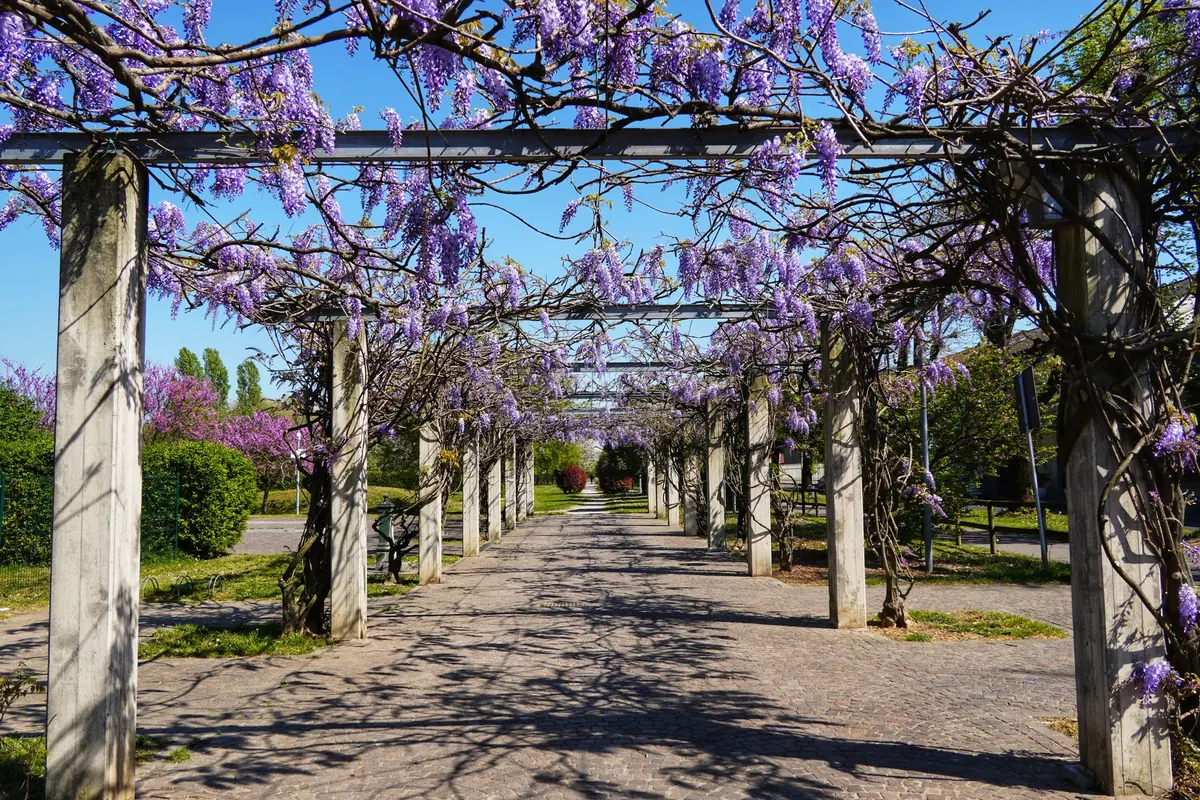
Fix galvanised wire, ideally 8–10 gauge, to vine eyes set into solid brick or stone rather than mortar joints, spacing the runs 30–45cm apart and tensioning them with turnbuckles. On a pergola, use substantial posts set in concrete — a lightweight arch will simply be pulled over. Tie stems in with soft twine in a figure-of-eight so nothing rubs, and check the fixings each winter. It is far easier to tighten a wire than to repair a wall.
Smaller mistakes that add up
- Watering only in the first month. New plants need steady water through their first two summers. Drought in year one sets them back badly.
- Chopping the leading shoot. Let one or two stems run up to the height you want before you start branching. Patience now saves years later.
- Judging a young plant. A grafted wisteria may still take three to five years to settle and bloom. Keep pruning and wait.
- Ignoring pests. Aphids and scale insects both leave sticky honeydew that soots up leaves. Wipe or wash it off and keep an eye on soft new growth.
- Forgetting it is toxic. Seeds and pods are harmful if eaten. Keep them away from children and pets, and speak to a vet or doctor promptly if anything is swallowed.
Letting it wander into the house
Shoots slip under roof tiles, into window frames, behind gutters and down into drains. Once inside, they can be surprisingly destructive and very hard to remove. Twice a year, walk round the plant with secateurs and trace every stray shoot back to the framework rather than snipping it at the point of entry — cutting the tip just encourages a thicker regrowth in the same place. Keep a clear 45cm gap around windows, doors and gutters.
A simple year with your wisteria
- January–February: winter prune the spurs to two or three buds, and check wires and fixings.
- March–April: mulch with compost, tie in new growth, remove any suckers from below the graft.
- May–June: water if the weather is dry, especially in the first two years. Feed only if growth is weak.
- July–August: summer prune the long shoots back to five or six buds.
- September–November: tidy stray growth away from the house, clear fallen pods and leaves.
Get those habits right and wisteria stops being a gamble. It becomes what it should be: a plant that fills a wall with scent and colour every May, and asks for little more than a sharp pair of secateurs twice a year.
Photo: Davide Comunian / Pexels